From Production Completion to Customer Dispatch: Where Manufacturing and Distribution Lose Visibility
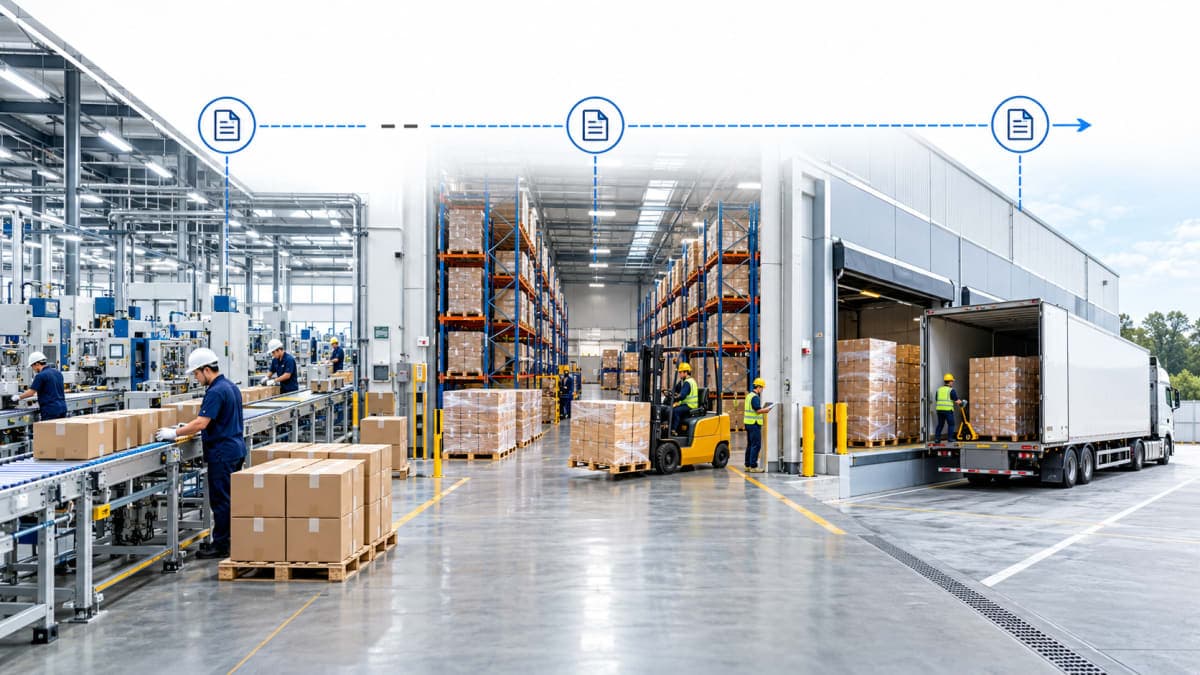
Production may be complete, but that does not necessarily mean finished goods are ready for customer dispatch. Inventory records may need updating, available quantities may require verification, and the distribution team may still be waiting for confirmation before shipping an order.
For manufacturers that also manage warehousing, sales, and distribution, these gaps can create delays even when the required goods have already been produced. The challenge is not always production capacity. Sometimes, the problem lies in how information moves between manufacturing, inventory, and distribution.
Effective manufacturing-to-distribution coordination helps businesses understand what has been produced, what is available, which orders can be fulfilled, and what remains before dispatch.
Why Production Completion Does Not Guarantee Dispatch Readiness
Production completion confirms that a manufacturing process has reached a particular stage. It does not automatically confirm that the finished goods have been recorded correctly, allocated to the right customer orders, or prepared for shipment.
Consider a manufacturer that completes 500 units of a product. The production team records the output, but the warehouse still needs to confirm the available quantity. Some units may already be committed to existing orders, while others may require inspection or additional handling.
Until these details are clear, the distribution team may not know how much stock can be shipped.
Businesses reviewing this process should consider how their manufacturing ERP system supports production records and how those records relate to the next operational steps.
Three stages need to be distinguished:
Production completion: The manufacturing process has produced the recorded quantity.
Finished goods availability: The goods have been recorded in inventory, and their usable quantity is understood.
Dispatch readiness: The required stock, customer order details, and applicable dispatch arrangements are ready.
When these stages are treated as separate activities without a clear handoff, completed production can remain disconnected from customer fulfilment.
Where Manufacturing and Distribution Lose Visibility
The visibility gap often develops when information passes between teams that rely on different records, systems, or working procedures.
1. Finished Goods Are Not Recorded Promptly
When finished goods are not reflected in inventory records promptly, the stock information available to warehouse and distribution teams may not match the physical situation.
The production team may report that goods are complete, while the inventory record still shows the previous balance. Alternatively, the recorded quantity may not reflect goods that are held for inspection or otherwise unavailable.
This is where finished goods inventory management becomes important. Businesses need to reconcile completed output with recorded stock so that the next team can make decisions using reliable information.
For a broader view of how inventory fits into business operations, see Multi-Techno's inventory management capabilities.
2. Production Output Does Not Match Available Stock
Manufacturing output and available inventory are not always the same thing. Goods may have been produced, but some quantities could already be committed to customer orders or unavailable for other reasons.
For example, a business may have 500 units recorded as produced, but only 180 units available for a new order after existing commitments are considered.
Without a clear view of production output, stock balances, and outstanding orders, employees may confirm quantities too early or delay orders while checking availability manually.
Businesses need a consistent process for comparing completed production with usable inventory and actual customer requirements.
3. Warehouse and Distribution Teams Work from Different Records
When warehouse employees and distribution staff rely on separate spreadsheets or disconnected applications, stock movements and order updates may not be reflected consistently.
The warehouse team might confirm that goods are physically present, while the distribution team is working from an older report. Employees then spend time checking quantities, comparing documents, and confirming order status.
This problem is closely related to the wider issue of manufacturing warehouse efficiency, particularly when stock visibility and coordination between departments become difficult to maintain.
The objective is not simply to give every department more reports. It is to make sure that the relevant records remain consistent and useful across the workflow.
4. Dispatch Progress Is Not Clearly Communicated
Even when the required stock is available, an order may still be waiting for picking, packing, documentation, or shipment arrangements.
If these activities are not recorded clearly, management may know that production is complete but remain uncertain about when the customer order will leave the warehouse.
A clear dispatch process should help employees distinguish between orders that are awaiting stock, orders being prepared, orders ready to ship, and orders that have actually been dispatched.
This distinction also improves customer communication because employees can provide an update based on the order's recorded status rather than an assumption.
What Disconnected Records Can Cost a Business
Visibility problems between manufacturing and distribution can affect order fulfilment, inventory decisions, and day-to-day coordination.
Delayed Customer Orders
When employees cannot confirm stock availability or dispatch readiness quickly, orders may wait for additional checks. This can happen even when production has already finished.
Inaccurate Inventory Decisions
If production and inventory records do not agree, managers may make decisions using incomplete information. They might arrange unnecessary replenishment, schedule production that is not required, or commit stock that is already allocated elsewhere.
Repeated Manual Reconciliation
Employees may need to compare production reports, inventory balances, sales orders, and dispatch documents to establish the correct status of an order. Repeated manual checks consume time and create more opportunities for mistakes.
Limited Management Visibility
Production reports alone cannot explain the complete fulfilment position. Managers also need to understand finished stock, outstanding customer orders, and dispatch progress.
Without that broader view, it can be difficult to determine whether a delay originates in production, inventory recording, order allocation, or distribution.
How to Improve Visibility from Production to Customer Dispatch
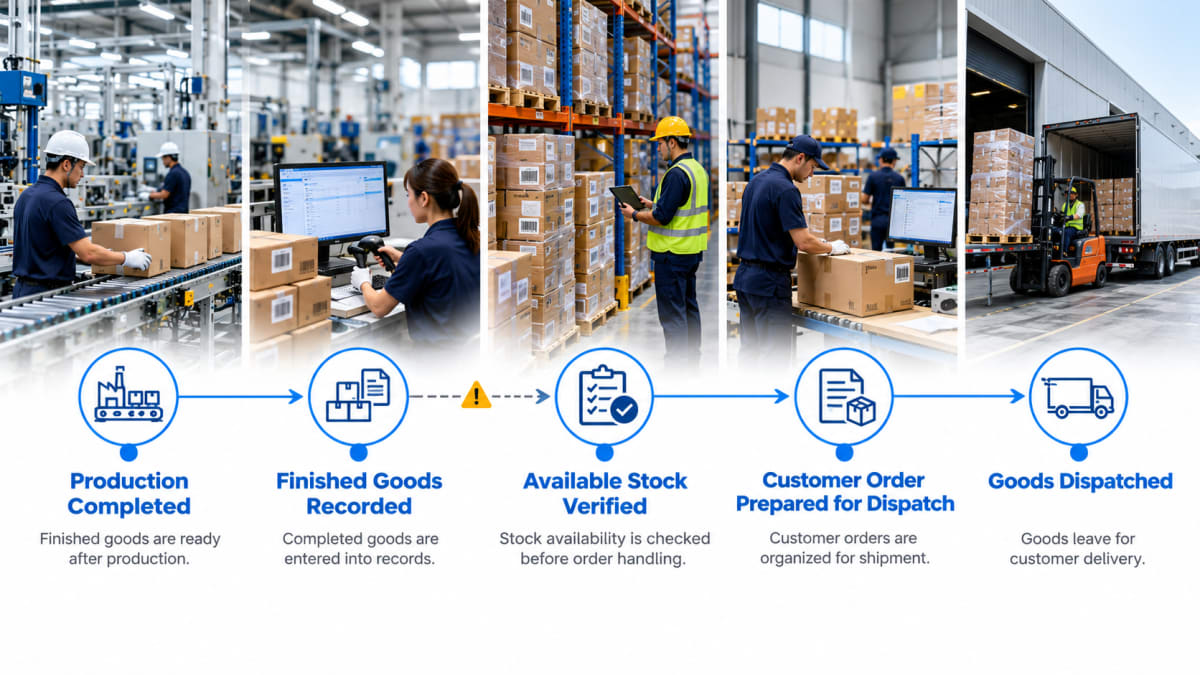
The solution starts with a consistent operational process. Each stage should produce reliable information that the next stage can use.
1. Record Production Completion Accurately
Production records should identify the relevant product, completed quantity, and production status. Where applicable, quality checks or rejected quantities should be handled according to the business's procedures.
This gives inventory and warehouse teams a reliable starting point for understanding what manufacturing has produced.
2. Reconcile Finished Goods with Inventory
Once production is complete, the business needs to confirm that the corresponding inventory records accurately reflect the goods available for use.
This means identifying discrepancies, accounting for unavailable quantities, and ensuring that the stock balance is suitable for order fulfilment decisions.
The relevant production management process should be considered alongside inventory controls so that production completion and the resulting stock position are not treated as unrelated activities.
3. Check Stock Against Customer Orders
Before committing goods to a new shipment, employees should verify the available quantity against the customer's order requirements.
Existing commitments, product specifications, and any stock restrictions must be considered. If the available quantity is insufficient, the business can identify the shortfall before making an unrealistic fulfilment commitment.
This step connects manufacturing inventory management with the practical requirements of customer order fulfilment.
4. Maintain Clear Dispatch and Goods-Movement Records
After stock availability is confirmed, the business should maintain records for the remaining fulfilment activities.
Depending on its operating procedures, this may include order preparation, picking, packing, dispatch documentation, recording goods movement, and delivery confirmation.
Each stage needs an appropriate status. An order that has been prepared but not shipped should not be recorded or communicated as a completed dispatch.
5. Investigate Delays Across the Full Workflow
When an order is late, teams should identify the stage where progress stopped rather than repeatedly checking the entire process.
Was production incomplete? Was the inventory entry missing? Was the available stock already committed? Was dispatch documentation pending?
Clear records make these questions easier to investigate and help managers distinguish between manufacturing issues and distribution issues.
How ERP Connects Manufacturing and Distribution
An enterprise resource planning (ERP) system can help businesses maintain consistent records across manufacturing, inventory, sales, and distribution. The actual benefit depends on the system's capabilities, configuration, and the accuracy of the transactions employees record.
Connect Production and Inventory Information
When supported by the system, connected production and inventory records can reduce the need to reconcile separate reports manually.
The aim is to establish a reliable relationship between what has been produced and what is recorded as available stock, while still allowing for required verification and stock controls.
Improve Order and Stock Visibility
Consistent inventory and sales records can help teams evaluate whether an order can be fulfilled and identify what still needs attention.
For businesses evaluating distribution-focused ERP solutions, the guide to ERP for the distribution industry provides a related perspective on distribution operations and their software requirements.
Manufacturers should assess whether their chosen system can support the specific order, inventory, and dispatch records their business needs rather than assuming every ERP offers the same functionality.
Support Coordination Across the Supply Chain
Manufacturing and distribution are connected parts of a wider operational process. Better coordination depends on reliable information moving between the people responsible for production, stock, orders, and delivery.
The broader concept of supply chain integration provides useful context for understanding why information gaps between operational stages can affect fulfilment.
Businesses can also review Multi-Techno supply chain management solutions when evaluating how their wider operations should be managed.
Connecting Manufacturing and Distribution with Multi-Techno
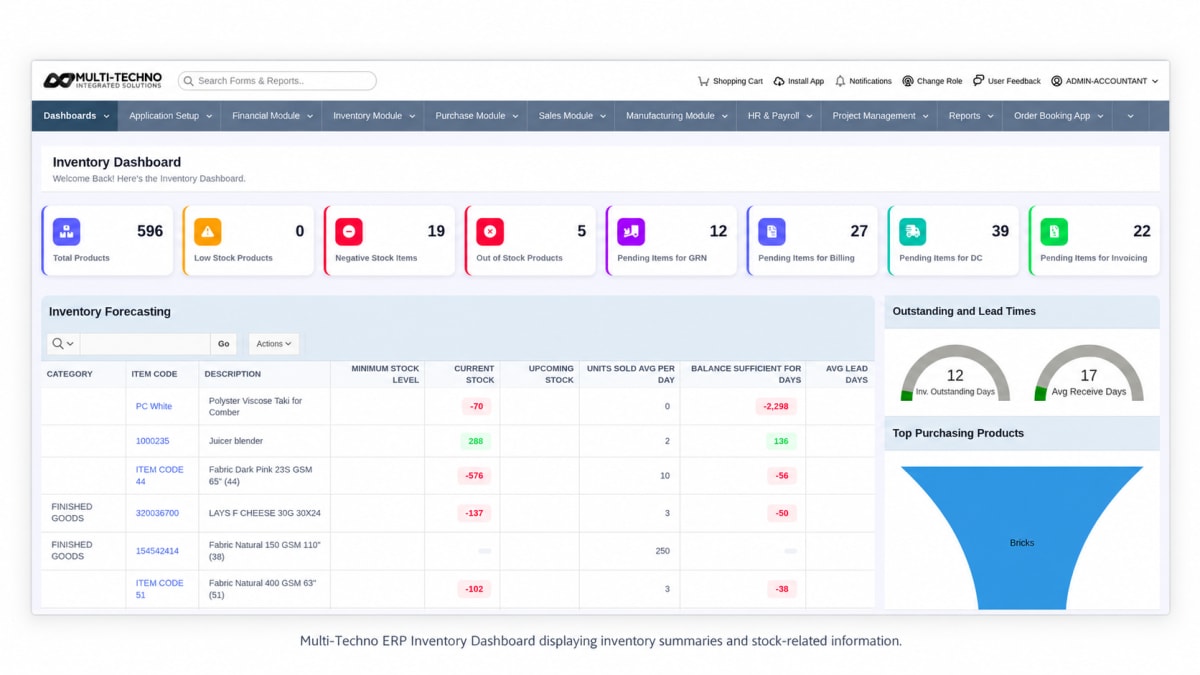
For manufacturers that also handle customer orders and distribution, the objective is to establish a clearer view of the journey from production completion to final dispatch.
Multi-Techno offers ERP solutions covering manufacturing, inventory, and supply chain management. Businesses can evaluate the available capabilities against their own production processes, inventory controls, order fulfilment requirements, and reporting needs.
Before selecting or configuring a system, it is important to confirm how it handles the specific stages relevant to the business, including production completion, finished goods inventory, stock availability, dispatch documentation, and delivery status.
Want to improve visibility from production completion to customer dispatch? Contact Multi-Techno to discuss your manufacturing and distribution workflow and evaluate an ERP setup that fits your operational requirements.