How Piece-Rate Pay Helps Factories Track Employee Production Output

Piece-rate pay compensates factory employees according to their actual production output rather than only the hours they work. When production records and employee piece-rate information are tracked together, factories can better connect employee output with manufacturing labor costs.
What Is Piece-Rate Pay in Manufacturing?
Piece-rate pay is a compensation system in which an employee's earnings are linked to the quantity of work or production they complete. Instead of calculating pay entirely from hours worked, the factory applies an agreed rate to the employee's completed output.
For example, if a worker is assigned a piece rate of $0.50 per completed unit and produces 200 units, the piece-rate amount for that output would be $100. The actual rate and calculation method depend on the factory's compensation policy.
This approach is commonly relevant where employee output can be measured against identifiable production activities, such as assembly, processing, or other repetitive manufacturing work.
A piece rate system can therefore give factories another way to measure employee contribution alongside working hours, attendance, and other payroll information.
Why Employee Output Matters When Calculating Manufacturing Labor Cost
Factory labor is not always represented accurately by hours alone.
Consider two production workers who each spend eight hours on the same type of manufacturing activity. One completes 100 units while the other completes 150. Their working time is identical, but their recorded production output is different.
With an hourly-only view, both employees have contributed the same number of working hours. With output-based tracking, the factory can also see how much production each employee completed.
This distinction becomes important when analyzing manufacturing labour cost. Production managers may need to understand not only how much time employees spent working, but also how that labor was associated with actual production.
Piece-rate tracking does not replace every other labor metric. Instead, it provides an additional connection between employee production and compensation where a factory uses output-based pay.
How Piece-Rate Pay Works With Factory Production
A practical piece-rate process starts with a production activity that can be measured.
The factory first defines the work being performed and the output that will be recorded. Employees then perform the assigned production activity, and the completed quantity is recorded against the relevant manufacturing operation.
The basic relationship is straightforward:
Production Output × Piece Rate = Piece-Rate Amount
For example, if a worker completes 300 eligible pieces at a rate of $0.40 per piece, the resulting piece-rate amount is $120.
In a manufacturing environment, however, the important part is not only the calculation. The factory also needs reliable production records showing what was produced, by whom, and under which production activity.
That is where an ERP can become useful. Instead of keeping employee output and production information in separate records, a manufacturing system can associate piece-rate information with the production activity where the work was performed.
How Multi-Techno Tracks Employee Piece Rate in Assembly Build
Multi-Techno supports employee piece-rate tracking within discrete manufacturing activities, including Assembly Build Piece Rate.
Assembly Build is used for production where components or materials are assembled into a finished product. When employees participate in this activity, their production contribution can be recorded along with the assembly work.
The piece-rate information provides a way to associate employee output with the assembly activity rather than treating employee pay as an entirely separate record.
For factories that use output-based compensation for assembly workers, this creates a clearer connection between:
Assembly Activity → Employee Output → Piece Rate
The exact piece-rate rules can still depend on the factory's own compensation structure. The ERP's role is to provide the production and employee records needed to manage that process consistently.
How Piece Rate Works With Work Progress
Piece-rate tracking is not limited to assembly activities.
In process-oriented production, employees may contribute to work that is recorded through Work Progress or Manufacturing Routing. Multi-Techno supports Work Progress Piece Rate, allowing employee piece-rate information to be associated with work progress activities.
This is particularly relevant when production involves stages rather than a single assembly event.
For example, a production process may involve several employees working on different stages of a batch. Recording work progress provides visibility into the production activity, while piece-rate information can identify the employee output associated with that work.
This makes the relationship between production records and employee compensation more structured:
Work Progress → Recorded Employee Output → Piece Rate
For factories operating both assembly and process-based production, having piece-rate tracking within the relevant manufacturing activities can provide a more consistent way to manage output-based labor information.
Same Hours, Different Output: A Simple Factory Example
Suppose two workers are assigned to the same production activity.
Worker A completes 100 units during an eight-hour shift, while Worker B completes 150 units during the same eight hours.
If the agreed piece rate is $0.50 per unit:
Worker A: 100 × $0.50 = $50
Worker B: 150 × $0.50 = $75
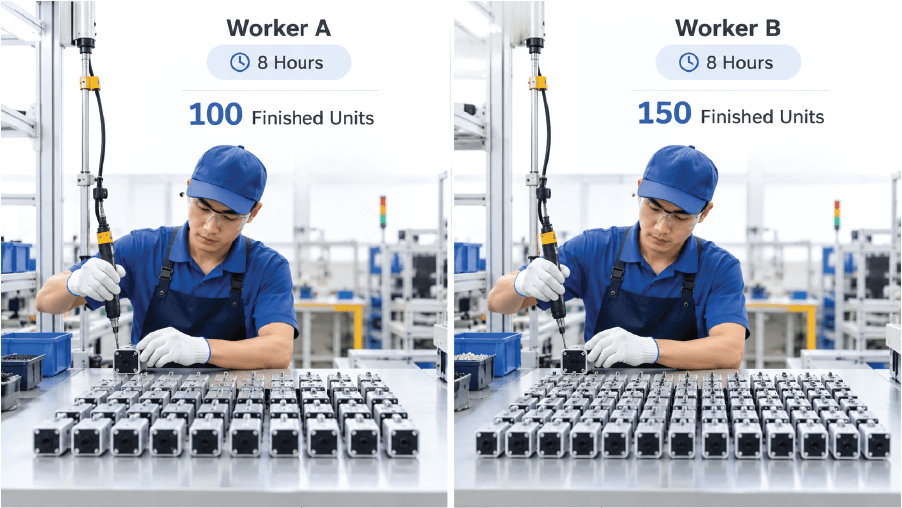
Both workers spent eight hours on the job, but their recorded output was different.
This example shows why piece rate production needs to be connected to actual manufacturing records. Without production-level output information, the factory may know how many hours employees worked but have less visibility into the production quantity associated with those hours.
The purpose is not simply to rank employees by output. The information can also help the factory understand how employee compensation relates to the production being completed.
How Piece-Rate Tracking Connects Manufacturing With Payroll
Piece-rate information becomes more useful when it can be considered alongside the factory's wider employee and payroll records.
Manufacturing ERP records describe the production activity. Employee records identify the person performing the work. Piece-rate information provides the output-based compensation component where the factory uses such a system.
This creates a connection between manufacturing and manufacturing payroll:
Manufacturing Activity → Employee Output → Piece-Rate Record → Payroll Information
The exact payroll treatment depends on how the organization has configured employee compensation and payroll rules. The important point is that employee output originates from the production process rather than being manually estimated after the fact.
For management, this can reduce the gap between what happened on the factory floor and the labor information used for payroll and costing.
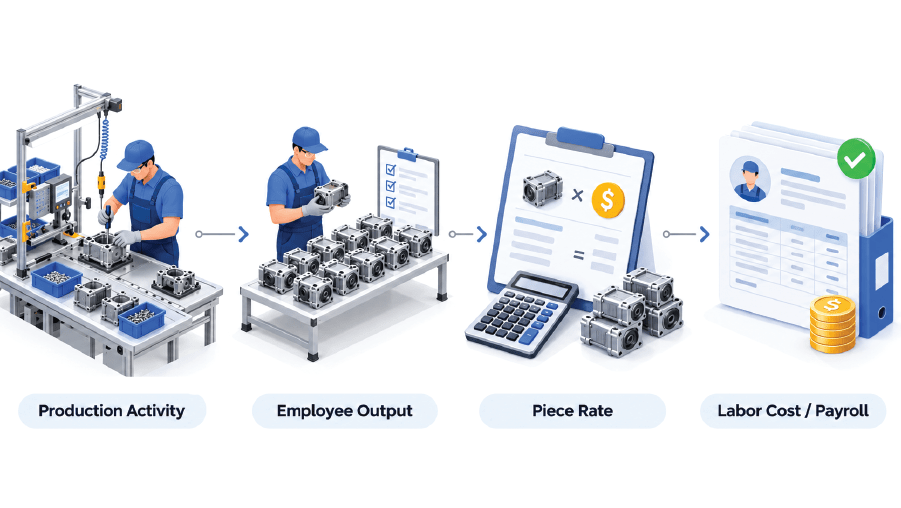
How Piece-Rate Data Helps Factories Understand Labor Cost
Piece-rate information can also contribute to a broader view of labor cost.
When employee output is associated with production costing & activities, managers can examine labor expenses in relation to the work being completed. This can help answer questions such as:
How much output was completed by employees?
Which production activity generated the recorded output?
What piece-rate compensation was associated with that output?
How does employee labor contribute to the overall production cost?
This is particularly useful when the factory wants to analyze manufacturing labor cost at the production level rather than looking only at total payroll expense.
For example, a factory may have a monthly payroll total, but that figure alone does not explain how much labor was associated with specific production activities. Production-linked piece-rate records can provide additional context for that analysis.
What to Look for in Manufacturing ERP for Piece-Rate Tracking
Factories considering a manufacturing ERP for output-based employee compensation should look beyond a basic payroll calculation.
The system should be able to connect employee records with actual manufacturing activities and provide a consistent way to record production output.
Important capabilities include:
Employee-Level Production Tracking
The system should identify which employee performed or contributed to a production activity and record the relevant output.
Piece-Rate Records Within Manufacturing
Piece-rate information should be associated with the production activity rather than maintained entirely separately from manufacturing records.
Assembly and Process Production Support
Factories may have different production models. A useful system should support piece-rate tracking across the activities relevant to the factory, such as assembly and work progress.
Manufacturing and Payroll Connection
Production output and employee compensation should be able to work together with the organization's HR and payroll processes.
Production Cost Visibility
The system should provide information that helps management understand labor expenses in the context of actual production.
FAQs
What is piece-rate pay in manufacturing?
Piece-rate pay is a compensation method where an employee's earnings are based on the quantity of eligible work or production completed rather than solely on hours worked.
How is piece-rate pay calculated?
A basic calculation is the employee's eligible production output multiplied by the agreed piece rate. The actual calculation can vary according to the factory's compensation policy.
What is the difference between piece-rate and hourly pay?
Hourly pay is primarily based on time worked, while piece-rate pay is linked to measurable production output. A factory can also use both methods as part of its overall compensation structure.
How does piece-rate pay work in a factory?
The factory records an employee's eligible production output and applies the applicable piece rate to that output. In an ERP environment, the production activity and employee information can be recorded together.
Can an ERP track employee piece-rate production?
Yes. A manufacturing ERP can record employee output against production activities and maintain piece-rate information where the system supports this functionality. Multi-Techno provides Employee Piece Rate tracking through Assembly Build Piece Rate and Work Progress Piece Rate.
How can piece-rate tracking help with manufacturing labor cost?
It connects employee compensation with actual production output, giving management more context when analyzing labor expenses and production costs.
Final Thoughts
Piece-rate pay gives factories a way to connect employee compensation with measurable production output. But the value of the approach depends on having reliable records of the work employees actually perform.
By connecting employee piece-rate information with manufacturing activities such as Assembly Build and Work Progress, an ERP can provide a more structured view of employee output, compensation, and manufacturing labor cost.
For factories using output-based compensation, this connection can make production and payroll information easier to manage and analyze from the same operational system.