Should Manufacturers Outsource Supply Chain Management or Integrate It Into ERP?

Manufacturers often face a difficult decision when supply chain operations become harder to manage: should they outsource supply chain management to a specialist provider, or integrate supply chain processes into their existing enterprise resource planning (ERP) system?
The answer depends on where the business needs support. Outsourcing can provide specialist expertise, operational capacity, and access to logistics networks. An integrated ERP approach can connect purchasing, inventory, production, and order management through shared business data. These approaches solve different problems, and many manufacturers benefit from combining them.
The right decision requires more than comparing service fees with software costs. Manufacturers must consider operational control, inventory visibility, production coordination, scalability, and the level of responsibility they want to retain internally.
This guide explains supply chain management outsourcing versus ERP integration, compares their benefits and limitations, and outlines how manufacturers can choose an approach that fits their operations.
What Is Supply Chain Management Outsourcing?
Supply chain management outsourcing means assigning selected supply chain activities to an external service provider rather than managing every activity internally.
Depending on the agreement, a provider may handle logistics coordination, transportation, warehousing, freight management, procurement support, demand planning, or other supply chain activities. Some providers specialize in a single service, while others coordinate several parts of the supply chain.
For manufacturers, managed supply chain services can be valuable when internal teams lack the resources, expertise, infrastructure, or geographic reach required to manage particular operations efficiently.
For example, a manufacturer expanding into a new international market may need freight coordination and regional distribution capabilities. Working with an experienced logistics provider may be more practical than building an entirely new logistics operation from scratch.
However, outsourcing does not automatically transfer every supply chain responsibility. The manufacturer may still need to manage supplier relationships, approve purchasing decisions, coordinate production schedules, monitor inventory, and maintain accurate financial records.
The exact responsibilities depend on the provider's scope of work, service agreement, reporting arrangements, and performance targets.
Why Do Manufacturers Outsource Supply Chain Activities?
Manufacturers may consider outsourcing when they need to:
Access specialist logistics or supply chain expertise.
Expand into new regions without building their own distribution infrastructure.
Increase operational capacity during periods of high demand.
Reduce the administrative burden on internal teams.
Improve transportation or warehousing coordination.
Obtain services that would be expensive or difficult to develop internally.
Outsourcing can be especially useful when the main challenge involves executing physical operations or accessing capabilities that the manufacturer does not currently possess.
The important question is whether the provider addresses the manufacturer's actual bottleneck—or simply introduces another organization that internal teams must coordinate with.
What Does Supply Chain Integration Into ERP Mean?
Integrating supply chain management into ERP means connecting relevant supply chain activities with the business processes and records managed through the ERP system.
Instead of maintaining separate, disconnected records for purchasing, inventory, production, and customer orders, an integrated system can allow authorized teams to work with shared information.
The exact functionality depends on the ERP platform, selected modules, integrations, and system configuration. However, a manufacturing-focused ERP environment may connect several important workflows.
Purchasing and Supplier Coordination
Purchasing teams need to understand which materials are required, what quantities are available, what has already been ordered, and when additional supplies may be needed.
When purchasing information is connected with inventory and production records, teams can make decisions using a more complete view of material requirements.
This can help reduce unnecessary purchases and highlight potential shortages before they disrupt production.
Inventory and Warehouse Visibility
Manufacturers need reliable information about available raw materials, work in progress, and finished goods.
An integrated supply chain management software approach can connect inventory transactions with relevant purchasing, production, and order records. Depending on the system's capabilities, this can make it easier to identify stock availability, monitor movements, and investigate discrepancies.
The benefit is not simply having inventory data in software. It is having inventory information that supports decisions across the business.
Production and Material Planning
Manufacturing schedules depend on material availability, production requirements, and the timing of incoming supplies.
When production and purchasing operate with disconnected information, a production team may discover a shortage only after a job is scheduled or work has started.
An integrated ERP workflow can help teams compare material requirements with available stock and purchasing records. This improves coordination, although the accuracy of the outcome still depends on reliable data, realistic planning, and timely transaction recording.
Customer Orders and Finished Goods
Once manufacturing is complete, finished goods must be recorded, allocated to customer orders, and prepared for dispatch.
When production, inventory, and order information are connected, teams can more easily determine whether an order is ready, which quantities remain available, and where delays require attention.
This is one reason manufacturing supply chain management should be evaluated across the full operational workflow rather than as a standalone purchasing or warehouse function.
Outsourcing vs. ERP Integration: Key Differences
The fundamental difference is that outsourcing provides external services or operational capacity, while ERP integration connects internal business information and workflows.
Outsourced Supply Chain Services
Outsourcing is primarily about obtaining capabilities from an external provider.
Operational execution: Providers may handle transportation, warehousing, freight, or other agreed activities.
Specialist expertise: Businesses can access skills and infrastructure they may not have internally.
Cost structure: Expenses may include service fees, storage, transportation, transaction charges, and contractual commitments.
Control and coordination: Manufacturers delegate selected responsibilities but must still manage the relationship, performance expectations, and information exchange.
Best fit: Businesses that need external capacity, specialist services, or access to established logistics networks.
Supply Chain Integration Into ERP
ERP integration is primarily about connecting information and internal workflows.
Operational coordination: Purchasing, inventory, production, and order records can work together within a connected system.
Information visibility: Teams can make decisions using shared data when records are accurate and updated consistently.
Cost structure: Expenses may include software, implementation, configuration, integration, training, and ongoing support.
Control and coordination: Internal teams generally retain responsibility for business decisions while using the system to coordinate activities.
Best fit: Businesses that struggle with disconnected records, manual reconciliation, and limited visibility across departments.
Neither option is automatically superior. The right choice depends on the business problem, existing capabilities, and the responsibilities the manufacturer wants to manage internally.
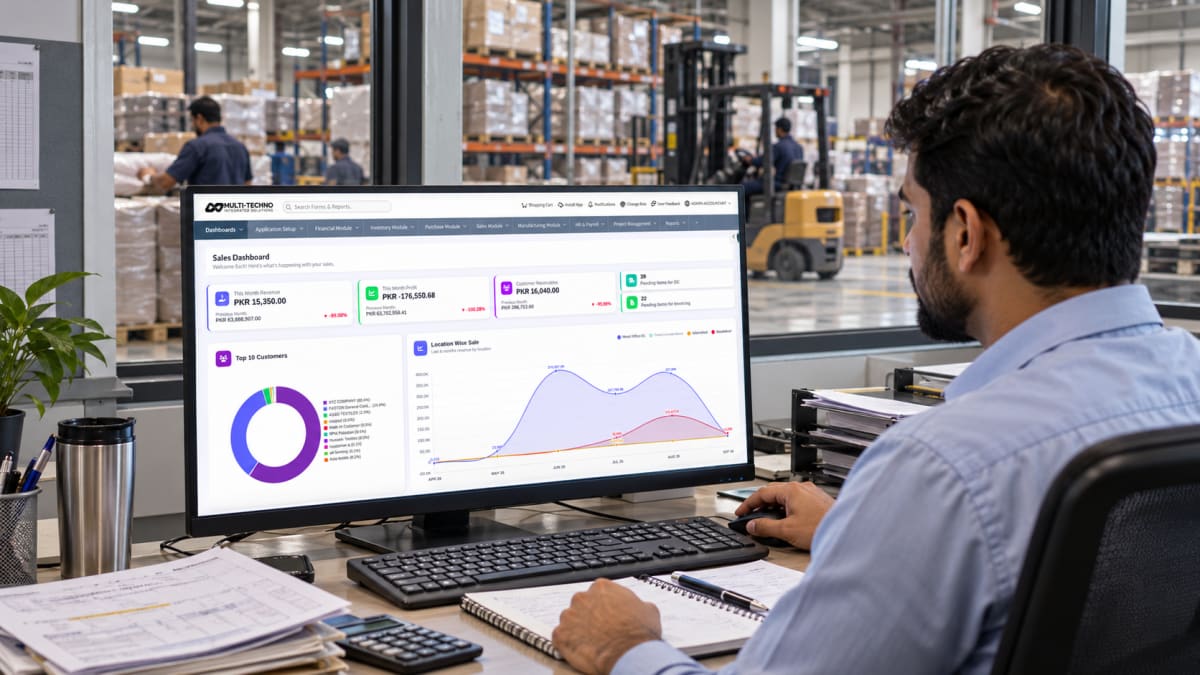
Cost Comparison: Outsourcing vs. ERP Supply Chain Management
A fair comparison must consider total cost rather than comparing a provider's quoted fee with an ERP subscription or implementation price.
The Cost of Outsourcing
The cost of outsourcing may include service fees, transportation charges, storage costs, transaction-based pricing, minimum commitments, and additional charges for exceptional requirements.
Manufacturers should also consider internal coordination time. If purchasing, finance, warehouse, and production teams spend significant time reconciling information from external providers, those administrative costs can affect the overall value of the arrangement.
Outsourcing may nevertheless be financially attractive when building the same capability internally would require substantial investment in people, facilities, technology, or specialist expertise.
The Cost of ERP Integration
ERP integration can involve licensing or software fees, implementation, configuration, data migration, integrations, employee training, and ongoing maintenance or support.
The initial investment may be significant, especially when existing processes are inconsistent or the manufacturer requires extensive customization.
However, the system can support multiple business functions through a shared operational foundation. Its value should therefore be assessed across the connected workflows it supports, rather than treating supply chain management as an isolated software expense.
How to Evaluate Total Cost
Before choosing either approach, estimate:
Direct service or software costs.
Internal staffing and administration requirements.
Implementation and transition expenses.
Costs associated with errors, delays, and duplicated work.
Ongoing integration, reporting, and coordination costs.
The financial impact of stock shortages or excess inventory.
The cost of scaling operations as production or order volumes grow.
A lower quoted price does not necessarily mean a lower total operating cost. Manufacturers should compare realistic scenarios using their own volumes, processes, and service requirements.
Which Approach Provides Better Supply Chain Visibility?
Supply chain visibility depends on whether decision-makers can access accurate, timely information about materials, inventory, production, orders, and external activities.
An outsourced provider may offer detailed tracking and reporting for the operations it manages. The usefulness of that information depends on the provider's systems, reporting frequency, data access, and integration with the manufacturer's processes.
An integrated ERP system can provide a connected view of internal activities when relevant records are maintained consistently. Purchasing, warehouse, production, and sales teams can work from shared records instead of relying entirely on separate spreadsheets or manually exchanged reports.
However, supply chain visibility is not guaranteed simply because a business adopts ERP software. Poor data quality, delayed transaction entry, disconnected third-party systems, and unclear process ownership can still create blind spots.
Manufacturers should assess whether their chosen approach answers practical questions:
Which raw materials are available, and where are they stored?
Which purchase orders are outstanding?
Are any materials likely to delay planned production?
What quantities have been produced and recorded as finished goods?
Which customer orders are ready for dispatch?
Which delays require intervention, and who is responsible for resolving them?
The best arrangement provides reliable answers without requiring employees to repeatedly reconcile unrelated records.
When Should a Manufacturer Outsource Supply Chain Management?
Outsourcing is worth considering when the primary requirement is an external capability that the manufacturer cannot efficiently provide itself.
It may be the stronger option in the following situations.
The business needs specialist logistics expertise. International freight, customs coordination, regional distribution, and complex transportation arrangements may require expertise and networks that take considerable time and investment to build.
The business is entering new markets. A third-party provider may already have facilities, partners, and operational knowledge in the target region.
Internal capacity is limited. If the manufacturer cannot justify hiring a full team or investing in its own warehousing and transportation infrastructure, outsourcing selected activities may be more practical.
Demand fluctuates significantly. External services may offer flexibility when operational requirements change considerably between periods.
The business needs execution rather than just better information. A manufacturer that needs goods physically stored, transported, or delivered requires operational services—not software alone.
Before signing an agreement, manufacturers should define service-level expectations, reporting requirements, responsibilities, data access, escalation procedures, and how performance will be measured.
When Should a Manufacturer Integrate Supply Chain Management Into ERP?
An integrated ERP approach is particularly relevant when the main challenge is fragmented information and poor coordination between internal departments.
It may be the stronger option in these situations.
Purchasing and production are disconnected. Production teams need accurate material requirements, while purchasing teams need visibility into upcoming demand and existing stock.
Inventory records are inconsistent. Multiple spreadsheets, manual updates, and separate departmental records make it difficult to determine what is actually available.
Customer commitments are difficult to verify. Sales teams need dependable information about inventory, production progress, and order readiness before confirming delivery expectations.
Management lacks a connected operational view. Decision-makers struggle to understand how purchasing, inventory, and production issues affect one another.
The business is growing in complexity. More products, suppliers, warehouses, production stages, or customer orders can make disconnected processes increasingly difficult to manage.
In these situations, ERP supply chain management can provide a structured way to connect operational records and decision-making.
The manufacturer should still assess the ERP system's actual capabilities. Some platforms require additional modules, third-party integrations, or customization to support particular workflows. A demonstration using the manufacturer's real processes is more useful than assuming every ERP product includes every supply chain function.
Can Manufacturers Combine Outsourcing and ERP Integration?
Yes. In many cases, combining both approaches is more practical than treating them as mutually exclusive alternatives.
Consider a manufacturer that purchases raw materials, produces finished goods, and sells to customers in several regions.
The business may use an integrated ERP system to coordinate purchasing, monitor internal inventory, connect production requirements with material availability, and manage customer orders. At the same time, it may outsource international freight, third-party warehousing, or regional delivery to specialist providers.
The ERP system supports internal coordination and recordkeeping. The external providers perform the services covered by their agreements.
For this model to work well, information must move reliably between the manufacturer and its service providers. Depending on the arrangement, that may require system integrations, standardized data exchanges, shared reports, or agreed procedures for updating shipment and inventory information.
A manufacturer should not assume that outsourcing automatically creates ERP integration, or that ERP integration eliminates the need for logistics partners. Both require deliberate coordination.
A Practical Manufacturing Example
Suppose a factory discovers that a critical raw material is running low.
With disconnected processes, the purchasing team may need to check warehouse spreadsheets, ask production for updated requirements, and contact suppliers before deciding what to order.
With an appropriately configured ERP system, the team may be able to review recorded stock, outstanding purchase orders, and production requirements in a connected workflow.
If the business also uses an external logistics provider, that provider can handle the agreed transportation activities once the purchase or shipment is ready. Relevant delivery information can then be shared with the manufacturer through the available reporting or integration arrangements.
The result depends on accurate records, clear responsibilities, and effective communication—not on software or outsourcing alone.
How to Choose the Right Supply Chain Management Approach
Before investing in a new system or signing an outsourcing agreement, manufacturers should evaluate their current operations.
1. Identify the Main Operational Bottleneck
Determine whether the problem is a lack of expertise, insufficient physical capacity, poor inventory accuracy, disconnected information, delayed purchasing decisions, or weak coordination between departments.
Different problems require different solutions.
2. Separate Internal Coordination From External Execution
List the activities that must happen inside the business and the activities that could be performed by an external provider.
For example, a manufacturer may want to retain control over production priorities and purchasing approvals while outsourcing transportation and warehousing.
This distinction prevents the business from outsourcing processes that require close internal oversight—or expecting software to perform physical services.
3. Assess Existing Systems and Data
Review how purchasing, inventory, production, and customer orders are currently recorded.
Identify duplicate data entry, manual reconciliations, missing records, and delays in communicating changes. These issues can indicate where ERP integration may help, although process and data problems must also be addressed during implementation.
4. Compare Total Cost and Operational Risk
Evaluate implementation costs, service fees, internal workload, supplier dependency, business continuity, data access, and the consequences of service interruptions.
Consider what happens if an external provider fails to meet expectations or if the ERP implementation takes longer than planned.
5. Define Measurable Success Criteria
Set practical targets before selecting a solution. Depending on the business, these may include inventory record accuracy, material availability, purchasing lead times, order fulfillment performance, production interruptions, and the time required to produce reliable management reports.
Establish a baseline so the business can determine whether the selected approach is delivering measurable improvements.
6. Verify the Solution Against Real Workflows
Ask providers and ERP vendors to demonstrate the processes that matter to the factory.
A useful evaluation should show how the proposed arrangement handles a real purchasing requirement, a stock shortage, a production demand change, and an order that depends on finished-goods availability.
This helps reveal gaps that may be hidden by general feature lists or sales presentations.
How Multi-Techno Approaches Integrated Supply Chain Management
For manufacturers whose primary challenge is coordinating internal business processes, an integrated ERP approach is worth evaluating alongside outsourcing options.
Multi-Techno provides ERP solutions designed around business and industry requirements. Its supply chain management solutions are relevant to manufacturers evaluating how supply chain processes can work alongside broader business operations.
The appropriate configuration depends on the manufacturer's requirements, existing systems, and the workflows that need to be connected. During an evaluation, manufacturers should establish which capabilities are available in the proposed configuration, which require integration or customization, and how external logistics or service providers would exchange information with the system.
Rather than assuming that one system will solve every supply chain problem, manufacturers should evaluate whether the proposed ERP setup can support their actual purchasing, inventory, production, and order-management processes.
A practical demonstration should use representative business scenarios and clarify the information available to each department, the records generated by each transaction, and any integration requirements.
Manufacturers can explore Multi-Techno's manufacturing ERP software and supply chain capabilities to assess whether an integrated approach fits their operational needs.
Frequently Asked Questions
Is supply chain management outsourcing better than ERP integration?
Neither is universally better. Outsourcing is useful when a manufacturer needs external expertise or operational services, while ERP integration is useful when internal processes and information need to work together. Many manufacturers use both.
What are managed supply chain services?
Managed supply chain services are activities performed or coordinated by an external provider under an agreed scope of responsibility. Depending on the provider, these may include logistics, transportation, warehousing, procurement support, or other supply chain functions.
Does ERP software replace a third-party logistics provider?
No. ERP software can support internal coordination and exchange information about relevant transactions, but it does not automatically provide physical transportation, warehousing, freight handling, or other outsourced operational services.
Can supply chain management software reduce inventory problems?
It can help by connecting inventory records with purchasing, production, and order information. The outcome depends on system functionality, accurate data, disciplined processes, and timely transaction recording.
Is ERP supply chain integration suitable for small and mid-sized manufacturers?
It can be, particularly when disconnected records and manual coordination are creating operational difficulties. The system should match the manufacturer's complexity, budget, implementation capacity, and growth plans.
What should manufacturers compare before choosing a supply chain solution?
They should compare total cost, operational control, inventory visibility, integration requirements, scalability, provider dependency, implementation effort, and the specific business problems each option addresses.
Can outsourced supply chain services and ERP software work together?
Yes. A manufacturer can use ERP to coordinate internal processes while outsourcing logistics, warehousing, transportation, or other activities. Reliable information exchange and clearly defined responsibilities are essential.
Final Thoughts
The decision between supply chain management outsourcing and ERP integration should begin with the problem the manufacturer needs to solve.
Outsourcing can provide specialist expertise, physical infrastructure, and operational capacity. ERP integration can connect purchasing, inventory, production, and customer orders through shared business information. One does not automatically replace the other.
For manufacturers struggling with disconnected records and limited internal visibility, integrating supply chain processes into ERP may be an important step toward better coordination. For businesses that lack logistics capacity or specialist expertise, outsourcing selected activities may be equally important.
The most effective approach is the one that aligns operational responsibility, reliable information, and total cost with the manufacturer's actual requirements.
Evaluate your manufacturing workflows before choosing a solution. Identify where delays and information gaps occur, determine which capabilities must remain internal, and assess which activities could benefit from external providers. Then evaluate an ERP configuration against real operational scenarios to establish whether it can support the connected workflows your business needs.