Why Reorder Point Planning Matters for Manufacturing Inventory Control

Reorder point planning helps manufacturers determine when raw materials and other inventory items should be replenished before available stock becomes insufficient for production. By considering material consumption, supplier lead times, and safety stock, manufacturers can make more informed purchasing decisions, reduce the risk of stockouts, and maintain better control over inventory levels.
In manufacturing, inventory replenishment is directly connected to production requirements. Ordering materials too late can interrupt production, while ordering too early can increase storage costs and tie up working capital. A structured reorder point strategy helps businesses balance material availability with inventory investment.
Why Reorder Point Planning Matters in Manufacturing
Manufacturing businesses depend on the timely availability of raw materials, components, and production supplies. Each material has its own consumption pattern, supplier lead time, and operational importance. Without a clear replenishment strategy, purchasing decisions may become reactive rather than being based on actual inventory requirements.
Reorder point planning provides a defined stock threshold for initiating replenishment. Instead of waiting until materials are nearly exhausted, manufacturers can identify when purchasing action should begin.
This approach supports several important inventory control objectives:
Maintaining sufficient raw materials for planned production.
Reducing the likelihood of unexpected material shortages.
Avoiding unnecessary purchases that increase excess inventory.
Giving procurement teams more time to coordinate with suppliers.
Improving coordination between inventory, purchasing, and production departments.
What Happens When Manufacturers Reorder Materials Too Late?
When a manufacturer delays purchasing until stock is almost exhausted, the remaining inventory may not be sufficient to cover material consumption during the supplier's delivery period.
For example, a production facility may consume a particular raw material every day. If the purchasing team places an order only when the remaining quantity is close to zero, the next delivery may arrive after the available stock has already been used.
This can create several operational problems:
Production schedules may need to be delayed or adjusted.
Procurement teams may have to arrange urgent purchases.
Businesses may face limited supplier availability or higher delivery costs.
Customer orders may be affected by production delays.
The impact can be more serious when materials have long supplier lead times or are difficult to source from alternative suppliers. Reorder point planning gives purchasing teams an earlier indication of when replenishment should begin.
Why Reordering Too Early Can Also Create Inventory Problems
Ordering materials earlier than necessary can create a different set of inventory challenges. Although additional stock may provide a temporary sense of security, excessive purchasing can increase storage requirements and tie up funds that could be used elsewhere in the business.
Materials that remain unused for extended periods may also become damaged, outdated, or unsuitable for changing production requirements.
Manufacturers should therefore consider the hidden costs of aging raw material inventory, rather than treating higher stock levels as an automatic solution to shortages.
The objective is not to maintain the highest possible inventory. It is to maintain an appropriate quantity that supports production without creating unnecessary inventory costs.
What Is a Reorder Point in Manufacturing Inventory?
A reorder point is the inventory level at which a business should initiate the replenishment process for a particular material or stock item.
It represents the point at which the remaining inventory is expected to cover material requirements during the supplier's lead time, along with an additional safety stock buffer where required.
For manufacturers, determining this threshold involves understanding three important factors:
Average material consumption.
Supplier delivery lead time.
Safety stock requirements.
For example, if a production facility regularly consumes a raw material and its supplier takes several days to deliver a replacement order, the business needs enough available inventory to cover expected consumption during that period.
The reorder point helps identify when the purchasing team should begin arranging the next supply.
How Reorder Point Differs from Minimum Stock Level
Reorder point and minimum stock level are related inventory control concepts, but they do not necessarily represent the same threshold.
A reorder point indicates when replenishment action should begin. It considers expected consumption during the supplier's lead time and any additional safety stock required.
Minimum stock level represents a defined lower inventory limit that a business wants to maintain.
For example, a manufacturer may decide to initiate purchasing when stock reaches 400 units while aiming to avoid inventory falling below a separate minimum threshold.
The actual relationship between these values depends on the business's inventory policies and how its ERP system is configured. Manufacturers should define both carefully instead of assuming that one automatically replaces the other.
Why Safety Stock Is Important
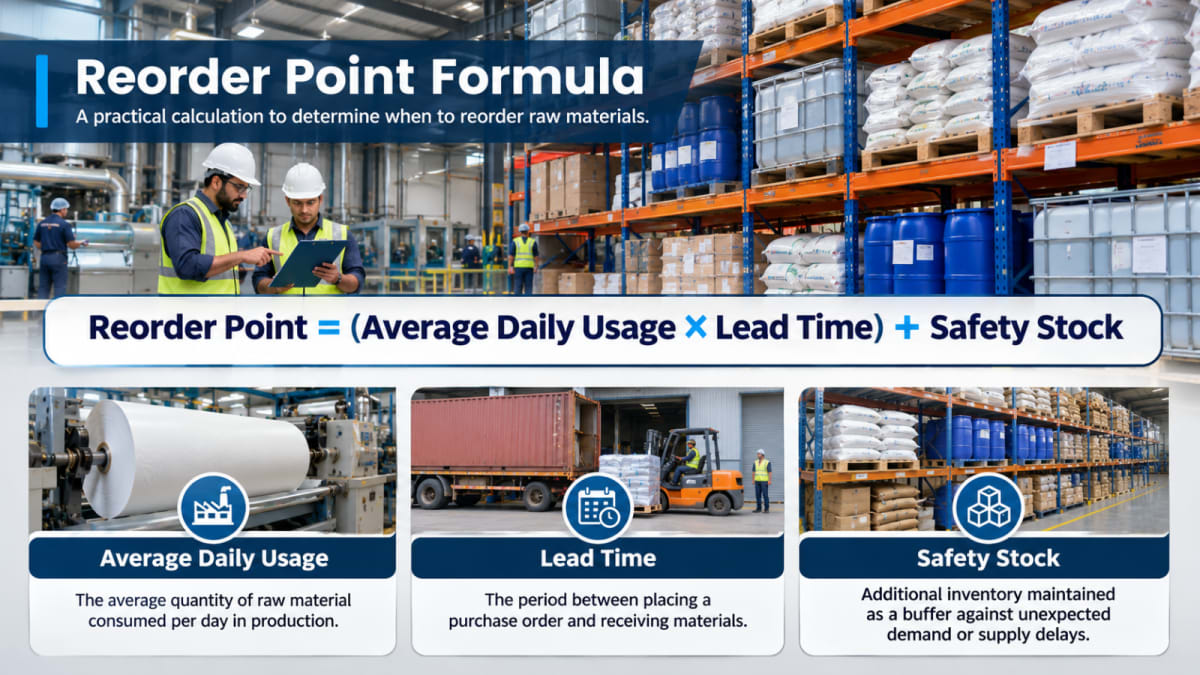
Safety stock is additional inventory maintained to protect operations against unexpected changes in demand or supply.
Even when a manufacturer has estimated average material consumption and supplier lead time accurately, actual conditions may vary. Production requirements may increase, suppliers may experience delays, or incoming materials may not arrive as scheduled.
Safety stock provides an additional buffer against these uncertainties.
However, the appropriate amount depends on the material's importance, consumption variability, supplier reliability, and the business's tolerance for production interruptions. A critical production material may require a different buffer from an item that is readily available from multiple suppliers.
How Manufacturers Determine the Right Reorder Point
An effective reorder point should reflect actual operating conditions rather than being based on an arbitrary stock quantity. Manufacturers need to evaluate material consumption, delivery timelines, and the additional inventory required to manage uncertainty.
Calculate Average Material Consumption
The first step is understanding how quickly a material is being consumed.
Manufacturers can review historical inventory issues and production usage to estimate average daily or weekly consumption. These figures should reflect actual material requirements as closely as possible.
For example, a manufacturer producing 500 units per day may consume a different quantity of raw materials than a facility producing 200 units per day. Changes in production volume can therefore affect the appropriate reorder threshold.
Accurate material consumption records help businesses understand how inventory moves through production and identify materials that require closer replenishment planning.
Historical consumption should also be reviewed regularly. Outdated figures may lead to reorder points that no longer reflect current production requirements.
Consider Supplier Lead Time
Supplier lead time is the period between placing a purchase order and receiving the materials.
This is an important factor because manufacturers must continue operating while waiting for incoming supplies.
A material supplied locally may arrive within a few days, while imported materials may require considerably longer due to transportation, customs, or supplier processing.
Manufacturers should consider:
Typical supplier delivery timelines.
Differences between local and international suppliers.
Supplier delivery consistency.
Transportation and customs delays where applicable.
Availability of alternative suppliers.
A material with a longer or less replenishment lead time may require a higher reorder point than an item that can be replenished quickly.
Determine Appropriate Safety Stock
After estimating material consumption and supplier lead time, manufacturers should determine whether additional inventory is needed as a buffer.
Safety stock requirements should reflect the operational importance of the material and the uncertainty surrounding its supply and consumption.
For example, a frequently used material that is difficult to source may need more protection against delays than a commonly available item with stable demand.
Using the same safety stock policy for every material can result in unnecessary inventory for some items and insufficient protection for others.
Calculate the Reorder Point
A commonly used reorder point formula is:
Reorder Point = (Average Daily Usage × Lead Time) + Safety Stock
Consider the following example:
Average daily material usage: 50 units
Supplier lead time: 6 days
Safety stock: 100 units
The calculation would be:
(50 × 6) + 100 = 400 units
Based on these assumptions, the manufacturer should review and initiate replenishment when the relevant inventory position reaches approximately 400 units, subject to its purchasing policy and any confirmed incoming supplies.
This is an illustrative example. Actual calculations may need to account for open purchase orders, committed inventory, demand variation, and the way a business defines available stock.
The reorder point should also be reviewed when production volume, supplier performance, or material consumption patterns change.
How Reorder Point Planning Supports Production Inventory Control
Reorder point planning connects inventory decisions with the practical requirements of manufacturing operations. It helps businesses determine when materials should be replenished so that purchasing activities can better support production schedules.
Maintain Raw Material Availability
Production depends on the availability of the materials required for each manufacturing process.
If an essential raw material becomes unavailable, production may have to wait even when machinery, employees, and other resources are ready.
Reorder point planning helps manufacturers establish replenishment thresholds for important materials before their available quantities become insufficient.
This is particularly useful for businesses handling multiple raw materials with different consumption rates and supplier delivery timelines. Manufacturers managing production through work orders should also consider how material requirements and availability are reviewed before production activities begin.
Reduce Production Interruptions
Material shortages can interrupt production schedules and create additional pressure on procurement and operations teams.
When purchasing decisions are based on defined reorder thresholds, businesses have a better opportunity to arrange supplies before inventory becomes critically low.
This does not eliminate every possible supply disruption. However, it reduces dependence on last-minute purchasing decisions and gives teams more time to respond when materials need replenishment.
Coordinate Inventory Replenishment with Production Requirements
Inventory requirements should not be considered separately from production planning.
Upcoming production orders, expected material consumption, and existing inventory commitments can all influence how much stock a manufacturer needs.
For example, a business preparing for an increase in production may need to review its material requirements before the additional demand reaches the warehouse.
Understanding production planning and material requirements helps purchasing teams make replenishment decisions that reflect actual operational needs rather than relying only on current stock quantities. Manufacturers can also use a Bill of Materials to understand the material quantities required for their products and establish a clearer basis for production-related material planning.
Manage Different Materials with Different Reorder Levels
Not every material should have the same reorder threshold.
A frequently consumed raw material may require regular replenishment, while a slow-moving item may remain in stock for longer periods. Similarly, a production-critical component with a long supplier lead time may need a different safety buffer from a readily available material.
Manufacturers should consider:
Material consumption frequency.
Production criticality.
Supplier lead time.
Availability of alternative materials.
Storage and handling requirements.
This item-specific approach helps businesses maintain more appropriate inventory levels across different material categories.
How ERP Supports Reorder Point Planning
An ERP system can support reorder point planning by organizing inventory information and providing visibility into stock levels and movements.
Instead of relying entirely on separate spreadsheets or manually maintained records, manufacturers can use centralized inventory information to review material availability and support purchasing decisions.
The exact functionality depends on the ERP system and its configuration.
Maintain Minimum Stock and Reorder Level Information
Defined minimum stock and reorder level information gives inventory and purchasing teams reference points for reviewing material availability.
When these values are maintained accurately, businesses can compare inventory positions against their replenishment requirements and identify items that may need attention.
The values should be reviewed when consumption patterns, production requirements, or supplier lead times change.
Review Inventory Balances and Stock Movements
A reliable replenishment decision requires an accurate understanding of inventory.
Material receipts, production issues, stock transfers, and other inventory transactions affect the quantities available to the business.
ERP inventory records, including item ledgers and stock movement information where available, help teams review these changes and understand how inventory balances have developed.
This is particularly important for manufacturers managing multiple warehouses or storage locations.
Better inventory movement and warehouse visibility can help teams investigate stock differences and make replenishment decisions using more reliable information.
Identify Materials Requiring Replenishment
Manufacturers need a practical way to identify materials that are approaching their defined stock thresholds.
Inventory information can help teams review current balances against minimum stock and reorder level values. This makes it easier to identify items that may require purchasing attention.
However, identifying a replenishment requirement and automatically generating a purchase order are two different capabilities. Businesses should understand which functions their ERP system actually supports before assuming that the entire purchasing process is automated.
Support Purchasing Decisions Through Inventory Reports
Inventory information becomes more useful when purchasing teams can review it alongside existing purchase records and supplier information.
This helps businesses evaluate whether materials need to be replenished, whether an order is already in progress, and whether the expected delivery timeline is suitable for upcoming requirements.
Organized purchasing and procurement processes also help connect inventory reviews with the actions required to maintain material availability.
What Manufacturers Should Consider When Setting Reorder Levels
Setting reorder levels requires more than choosing a stock quantity. Manufacturers should review the operational and supply-related factors that influence material availability.
Before defining or updating reorder levels, consider the following:
Historical consumption: Use recent and reliable material usage information rather than outdated averages.
Supplier reliability: Consider whether suppliers consistently deliver within their expected timelines.
Lead time: Account for the actual time required to receive materials after placing an order.
Material criticality: Give additional attention to items that can directly interrupt production if unavailable.
Storage capacity: Make sure replenishment quantities are practical for available warehouse space and material handling.
Seasonal production: Review inventory requirements when production demand changes during particular periods.
Demand changes: Update reorder thresholds when production volume or customer requirements increase or decrease.
Inventory accuracy: Ensure that recorded stock balances reflect actual receipts, issues, and transfers.
Review frequency: Reassess reorder levels periodically and whenever significant operating conditions change.
These considerations help manufacturers maintain reorder thresholds that remain relevant to their current production and purchasing requirements.
Common Reorder Point Planning Mistakes
Even when manufacturers understand the concept of reorder points, inaccurate assumptions can lead to ineffective replenishment decisions.
Using Outdated Consumption Data
Material consumption can change when production volume, product mix, or manufacturing processes change. Using old consumption figures may result in reorder points that no longer reflect actual requirements.
Ignoring Supplier Lead Time
A reorder point based only on available stock and average consumption may be insufficient if supplier delivery time is not considered. Manufacturers should use realistic delivery timelines when calculating replenishment thresholds.
Setting the Same Reorder Level for Every Material
Different materials have different consumption patterns, operational importance, and supply conditions. Applying identical thresholds across all items can create excess stock in some categories and shortages in others.
Ignoring Safety Stock Requirements
Unexpected demand and supplier delays can affect material availability. Manufacturers that do not consider an appropriate safety buffer may have less time to respond when actual conditions differ from expectations.
Treating Incoming Materials as Available Inventory
Materials that have been ordered but not yet received should not automatically be treated as physically available stock.
Purchasing teams should review open orders and expected delivery dates separately when evaluating replenishment requirements. Otherwise, businesses may underestimate their immediate material needs or place unnecessary duplicate orders.
How Multi-Techno ERP Supports Manufacturing Inventory Control
Multi-Techno ERP provides inventory management capabilities that help businesses maintain inventory information and review stock movements. Its inventory functionality includes features such as Minimum Stock, Reorder Level, Item Ledger, Stock Movement, and inventory reporting.
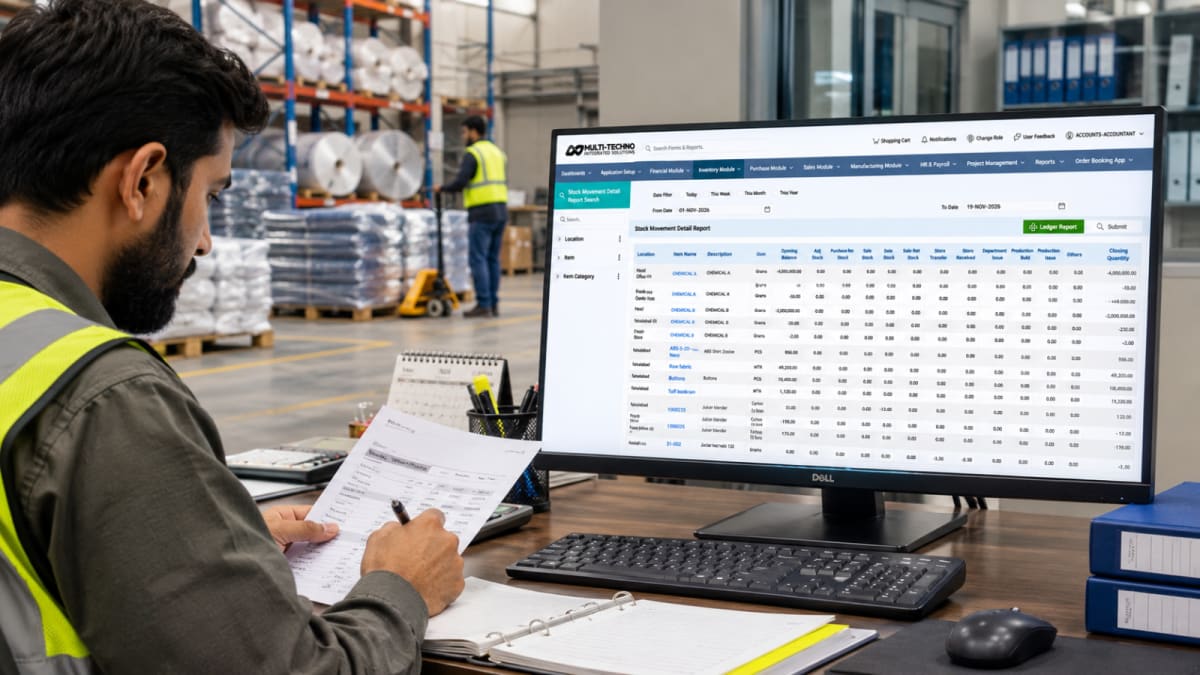
These capabilities can support manufacturers in organizing inventory records and reviewing stock availability as part of their replenishment and purchasing processes.
Minimum Stock and Reorder Level
Minimum Stock and Reorder Level provide inventory reference values that businesses can use when reviewing material availability.
Maintaining appropriate values helps inventory teams identify stock levels that require attention and supports more structured replenishment decisions.
Item Ledger and Stock Movement
Inventory transactions affect the quantities available for production and purchasing decisions.
Item Ledger and Stock Movement information can help businesses review inventory activity and understand changes in stock balances over time.
This supports better visibility into material receipts, issues, and other inventory movements.
Inventory Reporting
Inventory reports provide businesses with information for reviewing stock balances and inventory activity.
These records can help purchasing and inventory teams identify items that need further review and evaluate replenishment requirements using available inventory information.
Connecting Inventory with Manufacturing and Purchasing
Inventory decisions are more useful when considered alongside manufacturing and purchasing requirements.
Multi-Techno provides manufacturing ERP capabilities for businesses that need to manage connected operational processes. Its manufacturing and inventory solutions can support a more organized approach to managing material information and business operations.
Manufacturers should also consider how inventory visibility, production requirements, and purchasing activities work together when evaluating their wider manufacturing operations.
The right ERP setup depends on the business's processes, requirements, and required level of customization. A demonstration can help manufacturers understand how the available functionality fits their actual workflows.
Frequently Asked Questions
1. What is reorder point planning in manufacturing?
Reorder point planning is the process of determining the inventory level at which a manufacturer should initiate replenishment. It considers material consumption, supplier lead time, and safety stock to help maintain sufficient materials for production.
2. How do manufacturers calculate reorder points?
Manufacturers commonly calculate reorder points by multiplying average daily material usage by supplier lead time and adding the required safety stock.
Reorder Point = (Average Daily Usage × Lead Time) + Safety Stock
The calculation should reflect actual consumption and realistic supplier delivery timelines.
3. What is the difference between reorder point and safety stock?
A reorder point is the inventory threshold that triggers replenishment. Safety stock is the additional inventory maintained as a buffer against unexpected demand or supply delays. Safety stock is one of the factors used when calculating the reorder point.
4. How does supplier lead time affect reorder levels?
Longer supplier lead times generally require manufacturers to initiate replenishment earlier because more inventory may be consumed before replacement materials arrive. Unreliable delivery timelines may also increase the need for an appropriate safety buffer.
5. Why is reorder point planning important for raw materials?
Raw materials are essential to manufacturing operations. Reorder point planning helps businesses identify when to purchase additional materials, reducing the risk of shortages that could interrupt production or delay customer orders.
6. Can ERP help manufacturers manage inventory replenishment?
Yes. ERP inventory capabilities can help manufacturers maintain stock information, review inventory movements, and compare available quantities against defined inventory thresholds. The exact replenishment and purchasing automation available depends on the ERP system.
7. How often should manufacturers review reorder levels?
Manufacturers should review reorder levels periodically and whenever significant changes occur in material consumption, production volume, supplier lead times, or demand. Critical materials and items with unstable supply conditions may require more frequent reviews.
8. What happens when inventory falls below the reorder point?
When inventory reaches or falls below the reorder point, it indicates that replenishment should be reviewed or initiated. The purchasing team should evaluate available stock, incoming orders, expected consumption, and supplier lead time before deciding on the next purchase.
Conclusion
Reorder point planning helps manufacturers balance raw material availability with inventory costs. By considering average material consumption, supplier lead times, and safety stock requirements, businesses can make more informed replenishment decisions and reduce their dependence on last-minute purchasing.
However, effective inventory control requires more than setting stock thresholds. Manufacturers also need accurate inventory records, visibility into material movements, and coordination between purchasing and production requirements.
An ERP system can support this process by organizing inventory information and helping teams review stock levels and movements. With appropriate inventory planning and reliable operational information, manufacturers can make better replenishment decisions and maintain more consistent production operations.
If your manufacturing business wants to improve inventory visibility and connect inventory processes with wider operational requirements, contact the Multi-Techno team to discuss your ERP requirements and explore a solution aligned with your business workflows.